Refrigerator Repair
Why Sammamish Ice Makers Scale Up and Seattle's Don't: 3 to 6.5 Grains of Well Water on the Plateau
Sammamish Plateau Water draws mainly from its own groundwater wells and reports a blended hardness of about 3 to 6.5 grains per gallon, several times Seattle's surface supply, so mineral scale is the default first hypothesis for a slow Sub-Zero ice maker anywhere on the plateau.
Compiled by Marta Fennimore Refrigeration technician — ice systems and water supply · 12 years in the trade EPA 608 certified
What people here assume is wrong with it
The usual assumption is that the ice-maker module has failed, or that the filter was a dud. Both are cheap to believe and easy to act on, which is why plateau kitchens end up with a second new filter and a replacement module before anyone has looked at the water the machine is actually being fed.
That instinct comes from advice written for surface-water cities. On the plateau it is the wrong first move, and the reason is not the appliance.
What is actually happening
Sammamish Plateau Water supplies this area primarily from its own groundwater wells, and the district describes the blended result as medium hard, ranging about 3 to 6.5 grains per gallon. The neighbouring NE Sammamish Sewer and Water District publishes 55 mg/L for its Evans Creek Valley wells and 68 mg/L for its plateau wells, which sits comfortably inside that range. Seattle, drawing from surface water, is down around a grain or two.
Well water carries dissolved calcium that surface water does not, and a refrigerator is a device that repeatedly evaporates and freezes small volumes of it. Every fill cycle leaves a trace behind on the inlet valve seat and around the ice mold. None of it matters for a year. Then the valve seat no longer closes cleanly, the fill volume drifts, and cubes come out small, cloudy and stuck together.
The useful part is that this applies to the whole service area rather than to individual houses. Klahanie, Pine Lake, Sahalee and Trossachs all sit on the same well-fed system, so we do not have to establish whether your particular address has hard water before we form a hypothesis. Scale is the plateau-wide default, and the diagnosis is quicker for it.
The evidence, in the order we look at it
First, the ice itself. Small, cloudy, hollow or fused cubes tell us the mold is not receiving a full, clean fill. Full-size clear cubes appearing too slowly are a different story and point at the harvest cycle instead.
Second, fill behaviour. We watch a live fill and time it, listening for the valve. A valve that buzzes and dribbles is not a failed solenoid in most plateau cases; it is a seat that has partly closed up.
Third, the filter and its housing. On this water the filter loads well before the end of its nominal interval, and a heavily loaded filter starves both the dispenser and the ice maker at once. That combined symptom is the one most often misread as a valve failure, and swapping the valve does nothing for it.
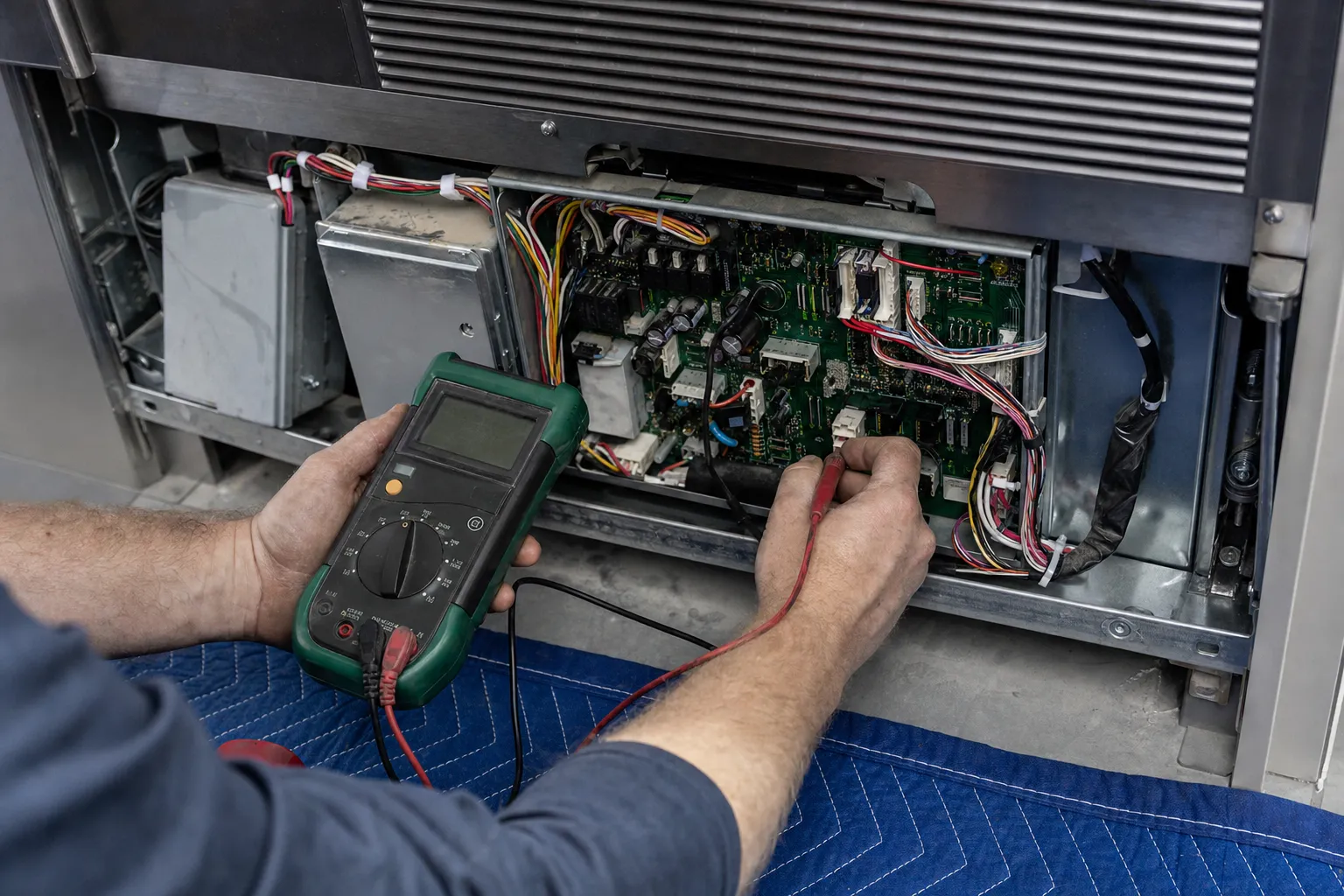
Fourth, the inlet valve screen. It is a fine mesh at the inlet side and it collects exactly what this supply carries. It comes out, gets inspected, and tells us more than the multimeter does.
Fifth, the mold, the ejector and the fill cup, checked for deposit at the water line. Only then the thermistor, the module and the harness, which are where a surface-water diagnosis would have started.
The fix that holds
Descaling and a shortened filter interval belong at the front of the job on the plateau, not tacked on at the end as advice. A mold and fill path cleaned properly, a fresh filter, and a valve whose seat is still sound will restore normal production without any part being replaced at all.
Where the seat is pitted rather than coated, cleaning buys weeks and the valve has to go. That distinction is worth making on the visit, because replacing a valve that only needed cleaning leaves the deposit upstream still in place and the same call comes back. The published range covering an ice maker, water valve or supply line repair here is $260 to $740, and an electronic control board, in the less common case where the fault really is electronic, is $400 to $940. The diagnostic visit is $89.
The part owners can carry forward themselves is the interval. On well-fed water, treating the filter as a calendar item rather than waiting for the dispenser to slow is the single change that keeps most of these calls from happening twice.
Where to stop and call
Stop at anything sealed. If the freezer section is not holding temperature, if there is frost building where there was none, or if the unit runs continuously without cycling off, that is a sealed-system or defrost question and not a water question, and the ranges there are different — a compressor or sealed-system repair runs $1,460 to $3,380.
Also stop if the water line behind the unit is damp. Pushing a built-in back into its opening over a weeping fitting turns a small plumbing job into a cabinet repair.
For everything else, the useful thing you can do before the visit is describe the ice. Whether the cubes are small, cloudy, hollow or simply slow tells us which end of the list to start at, and on this plateau that is usually enough to bring the right parts. (425) 610-8986 during opening hours; the booking link works whenever you do.
Common follow-ups
Is Sammamish water hard enough to damage a refrigerator?
It will not damage the refrigeration, but it does affect the water path. Sammamish Plateau Water reports a blended hardness of about 3 to 6.5 grains per gallon from its groundwater wells, and the nearby NE Sammamish district publishes 55 to 68 mg/L across its wells. That is enough dissolved calcium to build deposit on an inlet valve seat and an ice mold over a few years of daily cycling.
How often should I change the water filter on the plateau?
More often than the label suggests. The nominal interval assumes average water, and well-fed plateau supply loads a filter faster than that. A practical sign is the dispenser slowing at the same time as ice production drops, which means the restriction is upstream of both. Treat it as a scheduled item rather than waiting for the symptom, and the ice maker generally stays out of trouble.
Does everyone in Klahanie and Trossachs get the same water?
Broadly yes, which is what makes diagnosis quicker here. Klahanie, Pine Lake, Sahalee and Trossachs are served by the same district system, fed primarily from its own wells with a connection to the regional supply. That means scale is a reasonable starting hypothesis for the whole plateau rather than something we have to establish street by street before looking at the valve and the mold.